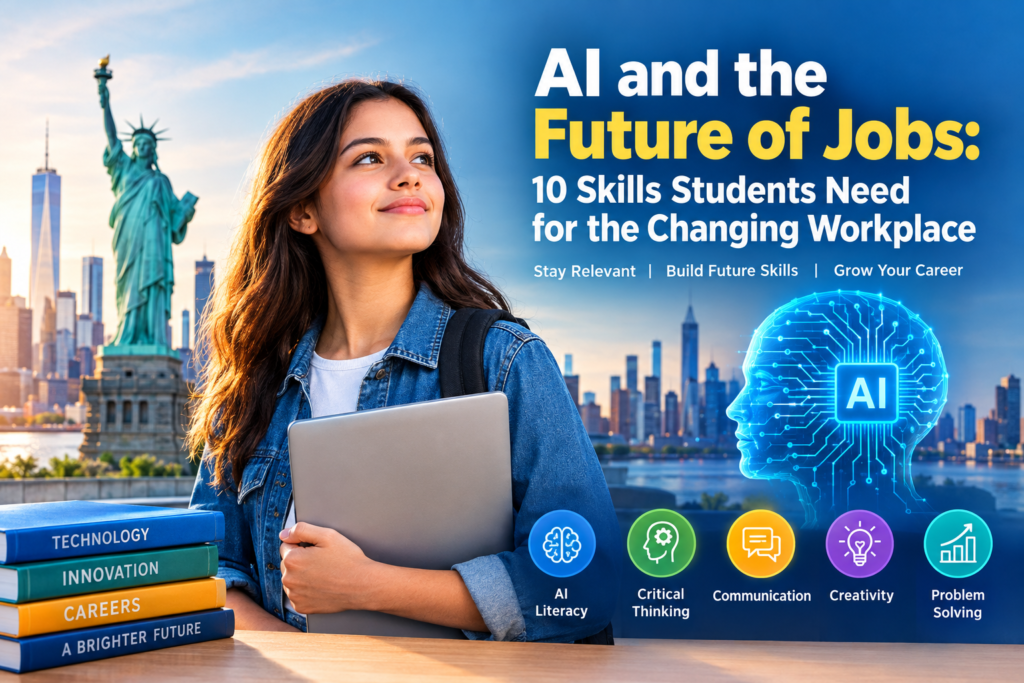
AI and the Future of Jobs: 10 Skills Students Need for the Changing Workplace
Artificial intelligence is changing the way people work across the US and around the world. Discover 10 essential skills students can develop to stay adaptable, competitive and prepared for the changing workplace.
Artificial intelligence is rapidly moving from a technology used mainly by specialists to a tool that is becoming part of everyday work and education. Across the United States, United Kingdom, Australia and Europe, employers, universities and governments are increasingly discussing how AI will change the skills people need to succeed.
The important question for students is no longer simply whether AI will affect their future careers. The bigger question is: Which skills will remain valuable as AI becomes more capable?
AI is changing the workplace
AI is already being used for tasks such as writing, data analysis, customer support, software development, research and administrative work. Recent international research indicates that people are increasingly concerned about the effect of AI on employment. A September 2026 Pew Research Center survey covering 37 countries found that more respondents expected AI to reduce jobs than increase them.
In Europe, the economic impact is also becoming a major issue. The International Monetary Fund has estimated that AI could increase productivity in Europe, while warning that adoption could also create pressure on some workers and widen differences between economies.
This does not mean that every job will disappear. Instead, many jobs are likely to change as people work alongside increasingly capable AI systems.
Why students need to prepare now
For today’s students, choosing a career only on the assumption that a particular profession will remain unchanged could be risky. A recent discussion in the UK education sector has emphasized the importance of adaptable skills rather than searching for a career that is completely protected from AI. Fields involving creativity, human interaction, physical environments, research and responsibility may continue to require substantial human involvement.
Students can therefore benefit from developing a combination of technical knowledge and human skills.
10 skills that can become increasingly important
1. AI literacy
Students do not necessarily need to become AI engineers. However, they should understand what AI can do, where it can make mistakes and how to use AI tools responsibly.
2. Critical thinking
AI can produce convincing answers that are incomplete or incorrect. The ability to check information, identify assumptions and evaluate evidence will remain important.
3. Communication
Clear writing, speaking, presentation and interpersonal communication are valuable across almost every profession. Technology can assist communication, but people still need to understand audiences and communicate ideas effectively.
4. Problem-solving
Employers need people who can identify problems and develop practical solutions. Learning how to approach unfamiliar problems can be more valuable than memorising information alone.
5. Data skills
Data is becoming increasingly important in business, engineering, healthcare, education and government. Students should understand basic data analysis, interpretation and visualisation.
6. Creativity
AI can generate text, images, designs and ideas, but human creativity remains important for defining objectives, understanding context and producing original concepts.
7. Digital skills
Students should become comfortable with common digital platforms, productivity software, online collaboration tools and emerging technologies.
8. Adaptability
Technology changes quickly. Students who are willing to learn new tools and update their skills throughout their careers may be better prepared for changing workplace requirements.
9. Collaboration
Future workplaces are likely to combine people with different technical and professional backgrounds. Teamwork, leadership and the ability to work with others will remain important.
10. Ethical decision-making
As AI becomes more powerful, questions involving privacy, misinformation, bias, security and responsibility are becoming increasingly important. Students should understand that using technology also involves making responsible decisions.
AI skills do not replace fundamental education
Learning AI tools should not mean ignoring fundamental subjects.
Mathematics, science, language, engineering principles, research methods and domain-specific knowledge provide the foundation on which technology can be used effectively.
A student who understands a subject deeply can use AI as a productivity tool while also checking whether its output makes sense. Someone who relies entirely on AI without understanding the underlying subject may find it difficult to identify errors.
The future may be about working with AI
The discussion about AI and employment is often presented as a simple question: “Will AI take people’s jobs?”
The reality is more complicated.
Some tasks may become automated, while other tasks may be redesigned. New roles may also emerge around AI development, implementation, supervision, cybersecurity, data management and responsible use.
Australia, for example, is also developing its approach to AI while emphasizing the need to create new employment opportunities as the technology develops.
For students, the practical lesson is clear: learning should not stop with a qualification. Continuous skill development is becoming increasingly important.
What students can do today
Students can start preparing without waiting for the next major AI breakthrough.
They can learn the basics of AI, practise using productivity tools, improve communication skills, work on real-world projects, build portfolios and develop strong knowledge in their chosen subject.
Most importantly, students should learn to use AI as a tool rather than depend on it as a substitute for thinking.
Conclusion
Artificial intelligence is becoming an important part of the global conversation about education, employment and economic growth. Its impact will differ across industries and countries, and it is still too early to know exactly how every profession will change.
What students can control is their preparation.
Strong subject knowledge combined with AI literacy, critical thinking, communication, creativity, problem-solving and adaptability can help students respond to a workplace that is changing rapidly.
The future of work may not belong simply to people who know AI or people who avoid it. It may increasingly belong to people who understand how to combine technology with human knowledge and judgment.