Communication Skills: English (311303) Question Bank
Important Questions with Answers
Students can access the Important Questions with Answers (Communicatoin Skills (English) 311303 provided by the department for their examination preparation. These questions are prepared to help students revise important concepts and focus on key topics from the syllabus.
Students are advised to use these materials along with their textbooks, classroom notes, and previous examination papers for comprehensive preparation.
Click here to get Important Questions for Comm. Skills (311303)
Also find all the Questions Below
Question Type (Question Number) Wise Question Bank
Communication Skills (English) 311303
By S.R. Nadaf (Sharad Institute Of Technology, Polytechnic)
Q 01. Attempt any FIVE of the following : (10 Marks)
1. What types of plastic material is found on the streets?
Used plastic bags, empty water bottles, biscuit wrappers, or even empty pan masala pouches can be found everywhere on the streets. Discarded plastic packets, bottles, and packaging waste from eateries are also common.
2. How is plastic an environmental hazard?
Plastic is an environmental hazard because it is non-biodegradable. A discarded plastic bottle can remain as it is for millions of years.
3. Compare the use of plastics by Indians, Europeans, and Americans.
An American consumes 80 kg of plastic per person per year, a European consumes 60 kg, and an Indian consumes 3 kg per year. Considering India’s population, even this is a large amount.
4. How are Goa and Ooty free from plastic use?
Goa and Ooty have strictly banned plastic use in any form. Citizens take pride in maintaining cleanliness, and shopkeepers use stylish newspaper bags instead of plastic.
1. What is the advice of Dr. Kalam to the new generation?
According to Dr. Kalam dreams are nothing but goals and mission in life and you should convert them into success in spite of problems.
2. What does Dr. Kalam think about failures?
Dr. Kalam believes every successful person faces failure. He considers failure a part of success and an opportunity to learn.
3. Write four qualities required for success stated by Dr. Kalam.
1. Clear aim in life
2. Acquiring knowledge in multiple ways
3. Hard work with devotion
4. Perseverance
4. Give any two examples of great personalities who inspired you most.
Dr. A.P.J. Abdul Kalam inspired me to think big and act with perseverance. Narayana Murthy inspired me to dream big, work hard, and maintain humility.
1. What should be the state of mind to experience happiness and peace?
To experience happiness, one must avoid negative emotions such as fear, anger, and frustration.
2. State the importance of laughter for a long-lasting relationship.
Laughter strengthens relationships. When laughter disappears, it’s often a sign of a relationship weakening.
3. What are the effects of ‘greed for money’?
Greed for money causes tension, worry, anxiety, and loss of peace of mind, sometimes leading to heart disease.
4. State seven keys to success.
Peace of mind, health, loving relationships, financial freedom, worthy goals, self-knowledge, and self-awareness.
1. What are the full forms of EQ, IQ, and SQ?
IQ – Intelligence Quotient, EQ – Emotional Quotient, SQ – Situational Intelligence Quotient.
2. What mistake did HR people realise in recruitment?
HR realized that candidates selected based on marks often lacked practical skills and work readiness.
3. Express the importance of scoring marks for your career.
Good marks help in gaining knowledge and securing admission to reputed institutes and jobs.
4. Summarize the suggestions given by the author to make one’s life remarkable.
To live remarkably: read inspiring books, stay with positive people, meditate, exercise, eat healthy food, and always believe in yourself.
1. Describe Arunima Sinha in two to three sentences.
Arunima Sinha is the first Indian amputee to climb Mount Everest. She was awarded the Padma Shri in 2015.
2. Name the academy started by Arunima Sinha and its motto.
She started Shahid Chandrashekhar Azad Viklang Khel Academy to provide sports facilities to poor, disabled children.
3. Mention the qualities of Arunima stated in the text.
She is hardworking, ambitious, kind, fearless, confident, and perseverant.
4. Narrate the experience of Arunima during the Mount Everest expedition.
Arunima faced the death zone filled with dead bodies but continued climbing despite exhaustion and pain. She reached the summit on 21st May 2013, proudly raising the Indian flag.
Q 02 Answer the following questions (ANY 03) in about 75-80 words (12 Marks)
1) What is the disastrous effect of plastics on the sea?
Ans: Marine life is greatly affected by the excessive use of plastic by humans. Used bottles, wrappers, cans, and tins are thrown into water bodies and reach the sea through drains. Plastic poses a severe threat to aquatic animals, as many mistake it for food and choke. Fish ingest plastic, damaging their digestive systems and affecting humans who consume them. If not controlled, plastic pollution will cause irreversible damage to the marine ecosystem.
2) How has plastic spoiled the land?
Ans: The production, usage, and disposal of plastic are increasing alarmingly. Plastic takes thousands of years to decompose. When thrown on land, it blocks water seepage, lowers the groundwater level, and reduces soil fertility. Animals that eat food from plastic bags suffer from malnutrition. Over time, plastic emits harmful chemicals like ethylene oxide and xylene, causing serious environmental damage and long-term harm to the ecosystem.
1) How does the success story of Dr. Kalam inspire the new generation?
Ans: Initial days of Dr. Kalam were full of hardships and failures. He faced these adversities with great determination and courage. His achievements give inspiration to all generations across the world. They tell us to always dream big, strive hard to achieve our goals, and persevere to be successful. He advises everyone to develop a positive attitude towards self and life. Throughout his life, he worked with complete devotion, dedication, passion, and inspiration. This teaches us to be truthful towards our work, and with his tendency to persevere, we can achieve anything in life.
2) Describe the qualities and achievements of any successful person.
Ans: Mr. Narayan Murthy is a man of great talent. He has transformed the face of the IT sector in India. He began Infosys with a meager capital of around ₹10,000. Within a span of 25 years, he changed Infosys into a global giant. This was not possible without a clear aim. He has always thought big and remained restless regarding his work. Perseverance, hard work, a positive attitude, clear and correct knowledge, leadership qualities, and dedication towards work are some of the qualities we admire in Mr. Narayan Murthy.
1) What is your aim in life? How have you planned to achieve it?
Ans: My aim is to become a successful engineer and set up my own business. I have planned to achieve this by first taking admission in a reputed polytechnic for diploma engineering. I am studying hard and aim to score distinction so that I can pursue B.E. at a Government College of Engineering. After B.E., I shall work in a company to gain experience and knowledge, conduct research in my field, and then establish my own firm, providing employment to others. Hard work and perseverance will help me achieve my aim.
2) How can a person with a positive attitude contribute to society?
Ans: A person with a positive attitude can contribute significantly to society. Even an individual’s efforts can make a big difference. Such a person can guide misled or depressed youth and serve as a source of knowledge and inspiration. An optimistic person shares experiences from a healthy and peaceful life, creating awareness in others. Qualities like peace of mind, financial freedom, worthy goals, self-knowledge, and loving relationships can be shared to motivate society, helping the youth become responsible towards themselves and the nation.
4. Mention the qualities of Arunima stated in the text.
Ans: The qualities of Arunima stated in the text are as follows:
- Hardworking: After completing a basic course from Nehru Institute of Mountaineering, she underwent rigorous training for 18 months to prepare for climbing Mount Everest.
- Ambitious: Her dream was to conquer the highest mountain on each of the seven continents, and till now, she has conquered six of them.
- Perseverant: She climbed various smaller peaks, including Island Peak, to prepare herself before Mount Everest.
- Kind-hearted and generous: She established the Shahid Chandrashekhar Azad Viklang Khel Academy for underprivileged handicapped children.
- Fearless: In the death zone, 3,500 feet from the summit, she saw dead bodies of mountaineers but did not give up.
- Confident: Even when her Sherpa advised her to return, she insisted she could not die before conquering Mount Everest.
1. Narrate the experience of Arunima during Mount Everest Expedition.
Ans: Arunima started her expedition on 1st April 2013. When she entered the death zone, 3,500 feet from the top, the most difficult terrain began. She saw dead bodies of mountaineers around, and a Bangladeshi mountaineer took his last breath in front of her. Frightened, she kept moving, telling herself she could neither go back nor die before reaching the summit. Her Sherpa advised her to return, but she remained determined. Motivated by her courage, he supported her further. She reached the summit on 21st May 2013, after 52 days, raised the Indian tricolour, and placed pictures of her idol, Swami Vivekananda, next to it.
2) Explain the importance of a teacher in a student’s life.
Ans: A teacher plays a very important role in a student’s life. A teacher imparts knowledge and teaches students how to gain more knowledge independently. Besides academics, a teacher instills moral values, shaping students into good human beings. A teacher can act as a guide, philosopher, counselor, and encourager. Teachers influence every aspect of a student’s life, helping them pursue a bright career and lead a successful life. They also motivate students during competitions and exams. Truly, a teacher is a blessing.
3) How did Ajay express his gratitude towards his teacher at the end?
Ans: In early 1991, after suffering a massive heart attack, Ajay recalled his teacher, Mrs. Sheila Kumar. He wrote to his old school, obtained her phone number, and later her address. He traveled to Dehradun after forty years to meet her. Ajay brought a bouquet of long-stemmed roses and presented it to Mrs. Kumar. During their conversation, he expressed his gratitude, recalling the care she had shown him and acknowledging how much he owed her. The roses symbolized his heartfelt gratitude.
Q. 03. Attempt any THREE of the following : 12 Marks
a) My Favourite Teacher
My favourite teacher is Mrs. Sharma. She teaches us English. She is very kind, helpful, and always smiles. She makes learning fun and easy. She explains everything clearly and listens to our questions with patience. She gives us good advice and motivates us to do better in life. She tells interesting stories and makes the class enjoyable. She never shouts and always encourages us to work hard. I like her way of teaching the most. Because of her, I have started loving English. She is not only my teacher but also my guide. I respect her very much.
b) The Best Moment of My Life
The best moment of my life was when I won the first prize in a drawing competition. I had worked very hard on my drawing. When the result was announced, I could not believe my ears. My name was called, and everyone clapped for me. I felt so happy and proud. My parents and teachers were also very happy. I received a big trophy and certificate. That moment gave me confidence and made me believe in myself. I will always remember that day. It was one of the happiest and proudest moments of my life.
c) Celebration of Cultural Event
Last month, our school celebrated a Cultural Day with great joy. Students wore traditional clothes and took part in different programs. There were dances, songs, and drama performances. Each class showed the culture of a different state in India. We also had food stalls with delicious traditional dishes. Teachers and parents enjoyed the performances and appreciated our efforts. The stage was beautifully decorated, and everyone was in a happy mood. We also had a prize distribution at the end. It was a day full of colour, music, and fun. Celebrating our culture made me feel proud and happy.
d) My Favourite Book
My favourite book is “Panchatantra Tales.” It is a collection of short moral stories with animal characters. I enjoy reading these stories because they are interesting and easy to understand. Each story teaches a good lesson like honesty, friendship, and wisdom. The animals in the stories are clever and funny, which makes the book more enjoyable. I like reading it before going to bed. It helps me learn new words and improves my reading skills. My parents gave me this book on my birthday. It is my best friend and I love reading it again and again.
e) My Favourite Hobby
My favourite hobby is drawing. I love to draw pictures of nature, animals, and cartoons. Whenever I have free time, I take out my colours and sketchbook. Drawing makes me feel relaxed and happy. It helps me show my thoughts and imagination on paper. My friends and family praise my drawings, which gives me confidence. I also take part in drawing competitions at school. I want to become a great artist one day. Drawing is not just my hobby; it is my passion. I enjoy it a lot and never get bored of it.
f) Laptop
A laptop is a useful electronic device. It is small and easy to carry anywhere. We can use a laptop for studying, working, watching movies, and playing games. Many people use laptops to attend online classes or meetings. It has a keyboard, screen, and a battery that works without electricity for some time. I also use a laptop to type my homework and search for information. It helps me learn new things. A laptop is faster than a mobile phone and better for reading or writing. It is very helpful in today’s modern world.
a) Dialogue between Two Students Discussing the Timetable of Final Exam (8–10 dialogues)
Ravi: Hi Suresh! Did you see the final exam timetable?
Suresh: Yes, I saw it on the notice board today.
Ravi: When is our first exam?
Suresh: It’s on 15th October. The first paper is English.
Ravi: Oh, good. I’m prepared for English. What’s after that?
Suresh: After two days, we have Science on 17th October.
Ravi: That will be tough. I need to study more.
Suresh: Don’t worry. We still have time to prepare.
Ravi: What’s the last paper?
Suresh: Maths, on 25th October.
Ravi: Alright! Let’s make a study plan.
b) Dialogue between Two Friends Discussing About Diwali Vacation (10–12 dialogues)
Amit: Hey Rahul, what are your plans for Diwali vacation?
Rahul: I’m going to my grandparents’ village.
Amit: That sounds fun! How long will you stay there?
Rahul: For about 10 days. I love celebrating Diwali there.
Amit: What do you do during Diwali in the village?
Rahul: We light diyas, burst crackers, and eat sweets.
Amit: Nice! I will stay at home and help my mom decorate.
Rahul: That’s great! Are you going to make rangoli?
Amit: Yes, and we’ll also invite guests for dinner.
Rahul: Diwali is such a happy festival.
Amit: Yes, it brings joy to everyone.
Rahul: Have a safe and happy Diwali, Amit!
Amit: You too, Rahul!
c) Dialogue between Two Friends About the Choice of a Career (10–12 dialogues)
Riya: Hi Sneha! Have you decided your career path?
Sneha: I’m thinking of becoming a teacher. What about you?
Riya: I want to become a doctor.
Sneha: That’s great! Why do you want to be a doctor?
Riya: I love helping people and I like science.
Sneha: That’s a noble profession.
Riya: Yes. Teaching is also a very respected job.
Sneha: I love explaining things to others.
Riya: That means you’ll be a great teacher.
Sneha: Thanks! Are you going to take science in college?
Riya: Yes, I will take science stream.
Sneha: I will choose arts.
Riya: All the best, Sneha!
Sneha: Same to you, Riya!
d) Dialogue Between a Student and a Teacher About Speaking English Fluently (10–12 dialogues)
Student: Good morning, Sir.
Teacher: Good morning. How can I help you?
Student: Sir, I want to speak English fluently.
Teacher: That’s a good goal. Do you practice speaking?
Student: Not much. I feel shy.
Teacher: Don’t worry. Start by speaking with friends in English.
Student: But what if I make mistakes?
Teacher: Mistakes help you learn. Just keep trying.
Student: Should I watch English movies?
Teacher: Yes, and read English books too.
Student: Can I speak with you daily in English?
Teacher: Of course! I’ll be happy to help.
Student: Thank you, Sir. I’ll start from today.
Teacher: Great! Keep practicing daily.
e) Dialogue Between Office Clerk and Student About Filling Examination Form (10–12 dialogues)
Student: Good morning, Sir.
Clerk: Good morning. How can I help you?
Student: I want to fill my exam form.
Clerk: Have you brought your ID and last marksheet?
Student: Yes, I have all the documents.
Clerk: Good. First, take this form and fill it.
Student: Do I need to attach a photo?
Clerk: Yes, one passport-size photo is needed.
Student: What is the last date to submit the form?
Clerk: The last date is 10th October.
Student: Is there a late fee after that?
Clerk: Yes, ₹200 will be charged as late fee.
Student: Okay, I’ll submit it today itself.
Clerk: Good. Submit it at counter number 3.
Student: Thank you, Sir!
f) Dialogue Between Two Students Regarding Their Future Plans (10–12 dialogues)
Pooja: Hi Anjali! What are your future plans after 12th?
Anjali: I want to become an engineer. You?
Pooja: I want to become a fashion designer.
Anjali: That’s interesting! Why fashion designing?
Pooja: I love drawing and creating new dress designs.
Anjali: That’s great! Where do you want to study?
Pooja: I plan to go to a design institute in Mumbai.
Anjali: I will prepare for engineering entrance exams.
Pooja: I wish you all the best!
Anjali: Thanks! I hope you achieve your dream too.
Pooja: Let’s work hard and make our parents proud.
Anjali: Yes! The future is in our hands.
Q. 04. Attempt any THREE of the following : 12 Marks
a) Smart Watch
A smart watch is a digital watch that does more than show time. It connects to a smartphone using Bluetooth or Wi-Fi. It can display calls, messages, and notifications. Many smart watches have features like a heart rate monitor, step counter, GPS, and sleep tracker. Some models allow users to make calls or play music. The touch screen is used to control functions. It has a rechargeable battery that lasts for one or more days. Smart watches are helpful for fitness, health tracking, and communication. They are small, easy to wear, and useful for daily life.
b) Laptop
A laptop is a portable personal computer. It has a screen, keyboard, touchpad (mouse), processor, RAM, storage (hard drive or SSD), battery, and various ports (USB, HDMI, etc.). Laptops are used for many tasks like typing, internet browsing, programming, watching videos, and playing games. They run on operating systems like Windows, macOS, or Linux. The battery allows users to work without being connected to power for a few hours. Laptops are lighter and more compact than desktop computers. They are useful for students, professionals, and travelers. Most laptops also have built-in speakers, a webcam, and Wi-Fi connectivity.
c) Refrigerator
A refrigerator is a home appliance used to keep food and drinks cold and fresh. It works using a cooling system with a compressor, refrigerant gas, coils, and a thermostat. The compressor pumps the gas through the coils, which removes heat and keeps the inside of the fridge cool. Modern refrigerators have two compartments – a fridge for regular cooling and a freezer for freezing items. Some models have digital displays, ice makers, and temperature control. They run on electricity and are energy-efficient. Refrigerators are important for food storage, preventing spoilage, and keeping items safe for longer use.
d) Solar Water Heater
A solar water heater is a device that heats water using energy from the sun. It has solar panels (called collectors) that absorb sunlight and convert it into heat. The heat is transferred to water stored in a tank, which is usually insulated to keep the water warm. There are two main types: flat plate collectors and evacuated tube collectors. Solar water heaters are installed on rooftops for maximum sunlight. They help save electricity or gas and are eco-friendly. These systems are used in homes, hotels, and industries. They are cost-effective in the long term and easy to maintain.
e) Printer
A printer is an output device that prints text or images from a computer onto paper. There are different types of printers, such as inkjet, laser, and dot matrix. Inkjet printers use ink cartridges, while laser printers use toner. Printers connect to a computer or mobile device using USB, Wi-Fi, or Bluetooth. Many modern printers also have scanning and photocopy functions, called all-in-one printers. Printers can be black-and-white or color. They are used in homes, schools, and offices for printing documents, photos, or assignments. Printers are easy to use and save time by providing quick and clear printed copies.
f) Audio Music System
An audio music system is an electronic device used to play sound and music. It usually includes speakers, an amplifier, and a music player or receiver. Some systems also include a radio, CD/DVD player, USB ports, or Bluetooth. The system converts electrical signals into sound through the speakers. The amplifier increases sound quality and volume. Audio systems can be large (home theater) or small (Bluetooth speakers). They are used at homes, parties, events, and even in cars. Many modern music systems also support wireless streaming. They give high-quality sound and improve the music listening experience.
g) Computer
A computer is an electronic machine that processes data and performs tasks. It has basic parts like a CPU (brain of the computer), monitor (screen), keyboard, mouse, and storage devices. Computers use software (programs) to do different jobs like writing, drawing, calculating, or browsing the internet. They work using an operating system like Windows, Linux, or macOS. Computers are used in schools, offices, homes, hospitals, and almost every field. They can store large amounts of information and work very fast. With internet access, computers can connect people all over the world. They are very useful in modern life.
Q. Describe the following picture in about 75 words.
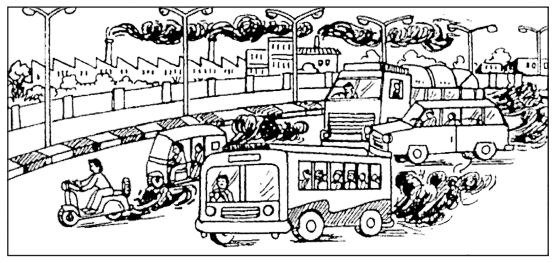
Ans : In the middle of the picture, there is a busy road full of traffic. A bus, cars, scooters, and auto-rickshaws are moving, and all are releasing black smoke into the air. On the top of the picture, we can see factories with tall chimneys giving out thick smoke. On the left side, a scooter rider is moving ahead. On the right side, cars and other vehicles are seen. In the background, buildings are visible. The picture shows heavy pollution everywhere, which is harmful to people and the environment.
Q. Describe the following picture in 75 words.
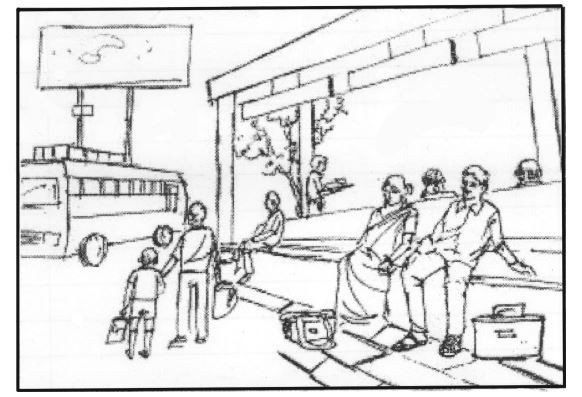
Ans : In the middle of the picture, we can see a bus stand where several people are waiting for the bus. On the right side, an old man and a woman are sitting with their bags. Behind them, some more passengers are also sitting. On the left side of the picture, a man and a child are walking towards the bus carrying bags. On the top of the picture, there is a big hoarding board. In the background, a man is standing under a tree. The scene shows daily life at a bus stand.
Q. Describe the following picture in 75 words.
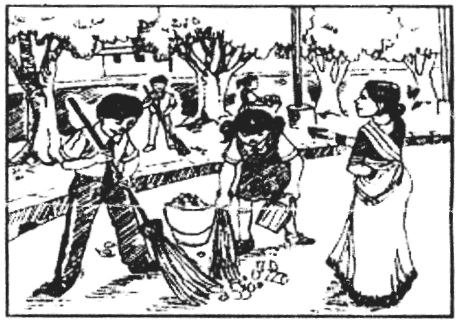
Ans : In the middle of the picture, we can see school children cleaning the ground with brooms. A boy and a girl are sweeping and collecting the garbage into a basket. On the right side, a lady teacher is standing and watching them. In the background, some more students are also sweeping near the trees. On the top of the picture, we can see several trees without leaves and some buildings far away. The scene shows the importance of cleanliness and teamwork among students.
You are Kanta/Raman. You have experienced an unusually happy day in your life.
Record your feelings in a diary entry of about 100 words.
Date:
Day:
Time:
Dear Diary,
Today was an unusually happy day, and I can’t help but pen down my overflowing joy. From the morning sun casting a warm glow to the laughter shared with friends, every moment felt like a blessing. The simple pleasures, the unexpected kindness, and the genuine smiles created a tapestry of happiness. It’s as if the universe conspired to make today exceptional. I find myself grateful for the smallest joys that made my heart light. This day will forever be etched in my memory as a reminder that happiness can be found in the simplest of moments. Gratitude fills my heart tonight.
Warmly,
Raman
It was the first day of your new college. Make a diary entry describing your first-day experience in your new college.
Date:
Day:
Time:
Dear Diary,
Today marked the beginning of a new chapter in my life as I stepped into my new college. The nervous excitement fluttered in my stomach, but the welcoming atmosphere quickly eased my worries. From the friendly faces in the orientation to the vibrant campus buzzing with activity, I felt a sense of belonging. Making new friends during ice-breaker sessions and exploring the campus added to the thrill. Professors introduced themselves, creating an engaging learning environment. As I walked back home, I couldn’t help but feel a mix of anticipation and eagerness for the exciting journey ahead. Here’s to embracing the adventure of college life!
Excitedly,
Raj
You recently visited an ‘Orphanage’ in Pune with your classmates. Make a diary entry of what you saw and experienced there.
Date:
Day:
Time:
Dear Diary,
Today was a profoundly moving day as my classmates and I visited an orphanage in Pune. The resilient spirit of the children touched my heart deeply. Despite their challenging circumstances, their smiles radiated warmth and hope. Interacting with them during various activities revealed their strength and resilience. The caretakers’ dedication was inspiring. We played games, shared stories, and brought a bit of joy to their lives. Witnessing the sense of community and love within the orphanage left me reflective. Today, I learned that kindness knows no bounds, and it’s our shared responsibility to uplift those around us.
Thoughtfully,
Raj
Q. 05. Attempt any TWO of the following : 12 Marks
Prefix:
- de- (reverse, remove):
– decode
– deflate - dis- (opposite, not):
– disagree
– disconnect - mis- (wrongly, badly):
– misinterpret
– misbehave - un- (not):
– uncover
– untangle - semi- (half, partly):
– semicircle
– semifinal - vice- (in place of, deputy):
– vice-chair
– vice-president - micro- (small, millionth):
– microscope
– microchip
Suffix:
- -ment (result or action):
– development
– improvement - -ship (state or condition):
– friendship
– leadership - -ful (full of):
– beautiful
– joyful - -ion (action or process):
– creation
– celebration - -al (related to):
– cultural
– musical - -ly (in the manner of):
– quickly
– happily
Synonyms
- Knowledge – wisdom, learned, educational
- Beautiful – attractive, graceful
- Dangerous – destructive, harmful
- Humorous – comic, amusing
- Dedication – devotion, commitment
- Guidance – counseling, guidelines, instructions
- Miracle – mystery, wonder
- Eminent – celebrated, well-known
- Zest – energy, enthusiasm
- Luxury – comfort, lavishness
- Ample – plentiful, abundant
- Anxious – worried, fearful
- Annual – yearly
- Popular – famous, beloved
- Zeal – enthusiasm, eagerness
- Knack – flair, genius
- Access – entry, way in
- Contract – agreement, undertaking
- Protect – save, shield
- Abundant – ample, plentiful
- Unique – special, distinctive
- Vacation – holiday, leave
- Modest – humble
- Accomplish – achieve, perform
- Adversity – misfortune, trouble, hardship
- Bondage – slavery, enslavement
- Compulsion – pressure, force
- Confuse – puzzle, amaze
- Dismal – somber, bleak
- Enormous – huge, vast, extensive
- Humble – modest
- Illegal – unlawful, illicit
- Pretty – beautiful, attractive
- Sympathy – empathy, affinity
- Obstacle – barrier, hurdle, problem
- Timid – fearful, shy, afraid, scared
- Variety – diversity, variation, difference
- Unique – rare, particular, uncommon
- Magnificent – glorious, majestic, splendid
- Vague – unclear, hazy, indefinite
Antonyms
- Guilty × Innocent
- Lend × Borrow
- Natural × Artificial
- Ancient × Modern
- Optimistic × Pessimistic
- Transparent × Opaque
- Trivial × Important, Significant
- Emigrant × Immigrant
- Famous × Unknown
- Imagination × Reality
- Permanent × Temporary
- Expand × Contract, Shrink
- Industrious × Lazy
- Diffident × Confident
- Ability × Inability
- Shy × Bold, Confident
- Coward × Brave
- Victory × Defeat
- Deep × Shallow
- Original × Duplicate
- Create × Destroy
- Urban × Rural
- Beautiful × Ugly
- Above × Below
- Accept × Reject
- Aggravate × Calm
- Benevolent × Unkind, Rude
- Frequent × Infrequent, Few
- Genuine × Bogus, Fake
- Hollow × Solid
- Ideal × Imperfect
- Kindle × Extinguish, Put out
- Material × Abstract
- Slender × Wide, Fat
- Rigid × Flexible, Loose
- Strange × Familiar
- Sympathy × Cruelty, Hostility
- Zenith × Nadir
Collocations:
- I told a joke to break the ice.
- Wear a jacket or you’ll catch a cold.
- I caught sight of a rare bird.
- The speaker caught the audience’s attention.
- Dry leaves can easily catch fire.
- Let’s come to the point.
- Hurry, or we’ll run out of time.
- We still had a good time despite the rain.
- I keep a diary every day.
- Her nod helped me get the message.
- In danger, always keep cool.
- Please keep an appointment with the client.
- I’d like to draw your attention to this.
- Tools help us save time.
- Talking helped us break the ice.
- You might catch a cold in this weather.
- We caught sight of a beautiful view.
- The ad was made to catch fire online.
- The speaker caught their attention quickly.
- Dry grass could easily catch fire.
Homophones:
- Vrunda’s handwriting is illegible.
- The principal of the college was present for the meeting.
- The reign of Akbar was spectacular in history.
- A horde of dacoits looted the village.
- Amit’s father is very industrious.
- They had mourning in their house at the death of their mother.
- We salute our army personnel.
- No desserts were served after dinner.
- I do not know whether my dad will come or not.
- The goods train is stationary.
- Ram is very weak.
- My new home is very spacious.
- The soldiers show a lot of mettle during wars.
- The boss complimented his employees on their success.
- The jasmine flowers are fragrant.
- Students should decide their goal by the age of 16.
- Dhoni always plays cricket with zest.
- I request you to reveal the secret.
- Arjun was sad at heart today.
Q. 06. Attempt any TWO of the following : 12 Marks
1. Vote of Thanks for Intercollegiate Technical Event
Respected Teachers, Honored Guests, Participants, and Friends,
I feel very happy to thank you all as we finish this wonderful intercollegiate technical event. Today showed us the power of teamwork, new ideas, and learning.
First, I thank our special guests and judges for giving their time and knowledge. Your presence made this event better and helped our participants a lot.
Thanks to our teachers for their support and hard work. Your dedication to teaching is very inspiring.
Thanks to all participants from different colleges who brought their energy and skills. You made the event lively and exciting.
A special thanks to the organizing team, volunteers, and technical staff who worked hard behind the scenes to make everything run smoothly.
Finally, thanks to our sponsors for their support. Your help made this event possible.
Let’s keep this spirit of learning and teamwork alive. Thank you all!
Rahul Sharma
Event Coordinator
2. Introduction of Guest Speaker on “Skill India”
Ladies and Gentlemen,
Good morning/afternoon! Welcome to this special talk on “Skill India.” Today, we have a very special guest with us who is an expert in skill development and supports the Skill India mission.
Our speaker, Mr. Arjun Patel, has many years of experience in this field and has helped improve skills for many people.
Skill development is very important for our country’s progress. Mr. Patel will share his knowledge and inspire us all.
Please join me in welcoming Mr. Arjun Patel.
Thank you.
Priya Verma
Student Coordinator
3. Speech to Introduce Chief Guest for First Year Induction Program
Ladies and Gentlemen,
Good morning/afternoon!
It is a great honor to introduce our chief guest for today’s first-year induction program. This is an important event for our institute.
Our chief guest, Mrs. Sunita Mehra, is very experienced and has done great work in education. She is known for her honesty, vision, and kindness.
Mrs. Mehra has inspired many students and professionals with her achievements.
We are lucky to have her here to guide us as we start our new academic journey.
Please welcome Mrs. Sunita Mehra.
Thank you.
Ankit Kumar
Program Host
4. Speech to Introduce Chief Guest Dr. Mehta for Workshop on “Goal Setting”
Ladies and Gentlemen,
Good morning/afternoon!
I am pleased to introduce Dr. Mehta, our chief guest for the three-day workshop on “Goal Setting.” Dr. Mehta is an expert in this field with many years of experience.
He has helped many people and organizations to set and achieve their goals successfully.
Goal setting is very important in both personal and professional life. Dr. Mehta’s workshop will teach us useful ways to plan and reach our goals.
Please join me in warmly welcoming Dr. Mehta.
Thank you.
Sonal Gupta
Workshop Coordinator
5. Vote of Thanks for Sports Events
Ladies and Gentlemen,
The Sports Events have come to a successful end. As the Sports Incharge, I thank you all.
Thanks to all players for their hard work and great spirit. You made this event exciting.
Thank you to our teachers and staff for their support.
Special thanks to our sponsors for helping us financially.
Thanks to the organizing team and volunteers for their efforts behind the scenes.
Finally, thank you to the friends and families who cheered and supported us.
Let’s keep the spirit of sportsmanship alive.
Thank you all.
Rohit Singh
Sports Incharge
6. Vote of Thanks for Annual Gathering
Good evening everyone,
I am happy to thank you all on this special day—our institute’s annual gathering.
Thanks to our teachers for their hard work and guidance.
Thank you to the non-teaching staff who keep everything running smoothly.
Thanks to the parents for their support and love.
We are grateful to the guest speakers for sharing their wisdom.
And thanks to my fellow students for all the fun and memories.
Thank you all for making this event wonderful.
Let’s look forward to more success together.
Thank you.
Neha Joshi
Student Representative
b) Explain gesture and posture as a form of non verbal communication with examples. in simple language
Gesture and posture are ways we communicate without using words. They are part of non-verbal communication.
Gesture: A gesture is a movement of your hands, arms, or head to express an idea or feeling.
Example: Waving your hand means “hello” or “goodbye.” Thumbs up means “good job” or “okay.”
Posture: Posture is the way you hold your body when you sit, stand, or move.
It can show how you feel or what you think.
Example: Standing straight with your shoulders back can show confidence. Slouching might show you’re tired or not interested.
Both gestures and posture help people understand your feelings and intentions without you saying a word!
c) Read the following passage carefully and answer the questions given below.
(This is just a sample paragraph in Board exam any unseen passage will be asked)
The culture of nuclear families is fashionable. Parents are often heard complaining about the difficulties of raising children these days. Too much freedom in demand, too much independence; overnight parties; excessive extravagance, wasting pocket money; no time for studies and family all this is a common cry of such families. Aren’t the parents themselves responsible for this sorry state? The basic need of a growing youth is family, love, care and bonding along with moral values. It should not be forgotten that “charity begins at home”. Both independence and individuality must be respected to maintain the sanctity of the family. Children today must be handled tactfully to bridge the ever-widening generation gap. Only reasonable demands should be met, as there are too many expenses to cover and too many social obligations to be taken care of by the parents. Our ancestors lived happily in close-knit families. The children loved living with their cousins, they learned to adapt to their means. There was perfect harmony between the generations. The concept of nursing homes never existed. There was deep respect for the elders in the family and love, care and concern for the
young. Even small family differences were resolved amicably.
i) Mention any two major common concerns of a nuclear family.
Too much freedom and independence demanded by children.
Excessive extravagance and wasting pocket money.
ii) State the basic need of a growing youth.
The basic need of a growing youth is family, love, care, bonding, and moral values.
iii) Describe the atmosphere in joint families.
In joint families, there was perfect harmony between generations. Children loved living with cousins and learned to adapt to their means. There was deep respect for elders and love, care, and concern for the young. Even small family differences were resolved peacefully.
iv) Explain the expression ‘Charity begins at home’.
The expression means that love, care, and good behavior should start within the family first before expecting it from others outside.