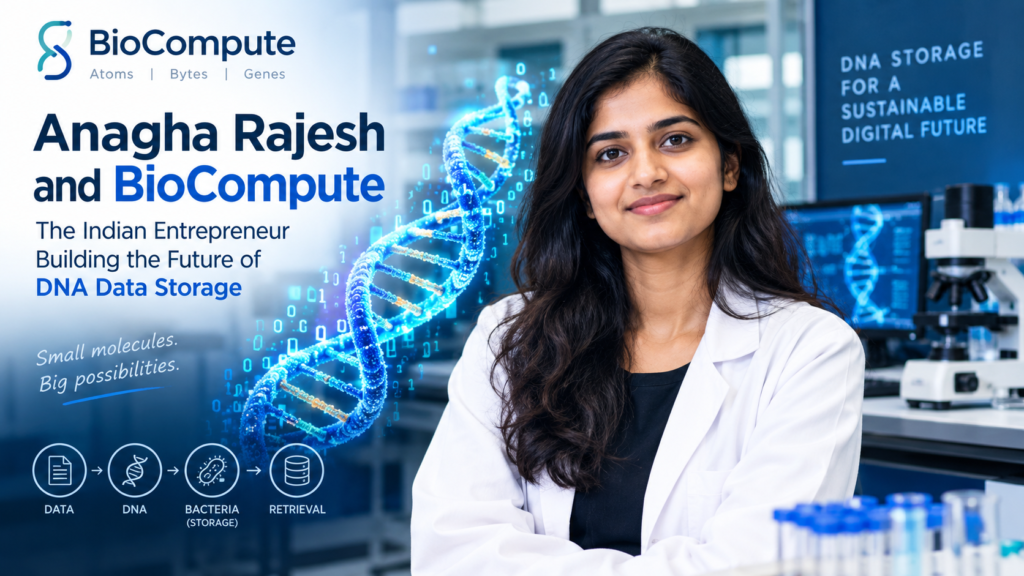
Anagha Rajesh and BioCompute: The Indian Entrepreneur Building the Future of DNA Data Storage
Learn about Indian entrepreneur Anagha Rajesh and BioCompute, the deep-tech startup developing DNA-based data storage technology for the future of digital infrastructure.
Imagine storing enormous amounts of digital information not on a hard drive, SSD or magnetic tape, but inside molecules of DNA.
This may sound like science fiction, but researchers have been exploring DNA as a data-storage medium for years. One of the young entrepreneurs working to turn this concept into a practical technology is Anagha Rajesh, founder and CEO of BioCompute.
Her Bengaluru-founded deep-tech startup is developing systems designed to write, store and read digital information using DNA and other biomolecules. BioCompute says its long-term vision is to build data infrastructure that uses the extraordinary information density and energy efficiency of biological molecules.
Who is Anagha Rajesh?
Anagha Rajesh is an Indian entrepreneur and deep-tech founder with a background in chemistry. She studied at BITS Goa, where she became interested in the intersection of science, technology and entrepreneurship.
Before BioCompute, Anagha was involved in scientific and social-impact initiatives. BITS Pilani’s records, for example, list her as an Ashoka Young Changemaker in 2022 and document several other achievements during her student years.
Her interest eventually shifted toward one of the world’s growing technological challenges: how to store the enormous amount of data being generated every day.
That question eventually led to BioCompute.
What is BioCompute?
BioCompute is a deep-tech startup developing DNA-based data-storage technology.
The company’s idea is based on a simple but powerful observation: DNA already stores biological information at extraordinary density. Instead of relying exclusively on conventional electronic storage technologies, digital information could potentially be encoded into DNA molecules and later retrieved through sequencing or other molecular-reading techniques.
BioCompute describes its work as building a full-stack data-storage system at the intersection of atoms, bytes and genes.
Its earlier technical description focused on an integrated system capable of writing, reading and storing information in bacterial DNA.
How does DNA data storage work?
At its simplest level, computers store information as digital bits, represented by 0s and 1s.
DNA, on the other hand, uses four chemical bases:
- A — Adenine
- T — Thymine
- C — Cytosine
- G — Guanine
Scientists can design methods that translate digital information into sequences involving these four bases.
For example, a computer file can first be converted into a binary sequence. An encoding system then maps that information into DNA sequences. The resulting DNA can be synthesized or modified, stored, and later read using sequencing technology.
The sequencing output can then be decoded back into the original digital information.
Why is DNA interesting for data storage?
DNA has several properties that make it attractive for long-term archival storage:
Extremely high information density: DNA molecules are extraordinarily compact compared with conventional storage media.
Long-term stability: Under appropriate conditions, DNA can preserve information for very long periods.
Biological compatibility: DNA is a natural information-storage molecule, meaning biology already provides mechanisms for copying, modifying and reading genetic material.
However, DNA storage is not simply a replacement for your laptop’s SSD. The technology faces major challenges involving writing speed, reading speed, cost, error correction, automation and integration with existing data infrastructure.
That is where companies such as BioCompute are trying to make a difference.
BioCompute’s breakthrough
According to BioCompute’s own timeline, Anagha conceptualized its approach in August 2023. The company was established in January 2024 and subsequently began incubation at the Centre for Cellular and Molecular Platforms (CCAMP) in Bengaluru.
In January 2025, the team set up a home laboratory.
Then came an important milestone.
In April 2025, BioCompute says it achieved its first proof of concept, successfully writing data into DNA and retrieving it.
Anagha also described the achievement publicly, saying the team had stored data in DNA by editing it and successfully read the information back using an Oxford Nanopore sequencer.
This is an important distinction: the achievement demonstrates a working proof of concept, not a commercially available DNA hard drive replacing today’s storage systems.
From a home laboratory to a deep-tech company
BioCompute’s journey is notable because the company moved from an early experimental concept to laboratory proof of concept relatively quickly.
According to its official timeline, BioCompute:
- Conceptualized the idea in 2023
- Was established in 2024
- Began work at CCAMP in Bengaluru
- Set up a home laboratory in early 2025
- Demonstrated its first DNA-storage proof of concept in April 2025
- Raised a pre-seed round in May 2025
- Established its own laboratory in Bengaluru
- Expanded its team
- Began automating parts of its biological laboratory workflow
The company has been backed by investors including 1517, gradCapital and angel investors, according to BioCompute’s own account.
Why does DNA storage matter?
The world’s demand for digital storage continues to grow.
Cloud services, artificial intelligence, video, scientific research, medical records, satellite imagery and countless other applications generate huge quantities of information.
Not all of this data needs to be accessed every second.
Some information is “cold data”: data that needs to be preserved but is rarely accessed.
This type of information could potentially be an important application for DNA-based storage.
BioCompute’s current vision is focused on developing data infrastructure that can take advantage of the density and energy efficiency of biomolecules.
Is BioCompute storing data inside living cells?
This is where headlines can sometimes become misleading.
BioCompute has described technology involving bacterial DNA, but DNA data storage as a field is broader than simply putting files inside living cells.
The company’s earlier description discussed writing, reading and storing information in bacterial DNA, while its more recent work is focused on building a complete DNA-storage system and reducing the cost and complexity of writing and reading molecular data.
Therefore, it is more accurate to describe BioCompute as developing DNA-based data-storage technology, rather than saying that it has created a conventional computer hard drive inside a cell.
BioCompute’s move to the United States
In June 2026, reports said BioCompute was moving its operations from Bengaluru toward the United States as it transitioned from prototype development toward product development.
The Economic Times reported that founder Anagha Rajesh cited the need for access to capital, talent and customers willing to take risks on frontier technologies.
The move does not erase the importance of the company’s Indian journey. BioCompute’s own timeline shows that significant early development, laboratory work and its first proof of concept took place in Bengaluru.
What could the future of DNA data storage look like?
If DNA storage becomes economically and technically competitive, its applications could extend far beyond today’s conventional archival systems.
Potential applications include:
- Long-term archival storage
- Scientific research data
- Government records
- Medical and genomic information
- Historical archives
- Large-scale cloud infrastructure
- Data generated by artificial intelligence
- Information that needs to be preserved for decades or longer
BioCompute’s ambition goes beyond simply storing files. Its stated vision involves using biological molecules as part of future computing and data infrastructure.
A September 2026 report in The Next Web described the company’s newer approach as focusing on reusable DNA templates to reduce the cost of writing information, with the broader goal of making DNA storage economically viable for “cold” data.
Anagha Rajesh’s journey is about more than DNA
The BioCompute story is also an example of how interdisciplinary research can lead to unconventional startups.
Chemistry, molecular biology, computer science, electronics, sequencing technology and data engineering all intersect in DNA data storage.
BioCompute’s current team reflects that interdisciplinary approach, with roles covering product development, electronics, bioengineering and software for reading and storing information.
The company is therefore not simply trying to create another storage device. It is attempting to build a bridge between biology and computing.
Anagha Rajesh and BioCompute represent an emerging generation of deep-tech entrepreneurs exploring technologies far beyond conventional computing.
DNA has evolved in nature as an information-storage molecule for billions of years. The challenge now is whether humans can adapt that biological information system for the enormous digital data requirements of the modern world.
BioCompute has already demonstrated an early proof of concept for writing and retrieving data using DNA. Its next challenge is much harder: making the technology scalable, affordable, reliable and useful in real-world data infrastructure.
If successful, the idea of a “DNA hard drive” could eventually move from the laboratory into data centers.
For now, however, BioCompute remains a deep-tech project at an early stage of a much larger technological journey.