What Is Agentic AI? How AI Agents Actually Work in 2026
AI agents are changing how people use artificial intelligence. Learn what agentic AI is, how AI agents work, what they can do, their benefits, limitations and future impact.
Artificial intelligence is moving beyond simply answering questions.
The next major shift is AI that can understand a goal, plan the steps required, use digital tools and take actions to complete a task. These systems are commonly called AI agents, while the broader approach is often described as agentic AI.
In 2026, AI agents are increasingly being explored and deployed for business workflows, software development, research, customer service and productivity. Google describes AI agents as systems that can use reasoning, planning, memory and tools to pursue goals, while OpenAI describes agents as systems that can independently accomplish tasks on a user’s behalf.
What Is an AI Agent?
An AI agent is a software system designed to achieve a goal by interpreting information, making decisions and taking actions.
A traditional chatbot generally works like this:
Question → AI response
An AI agent can work more like this:
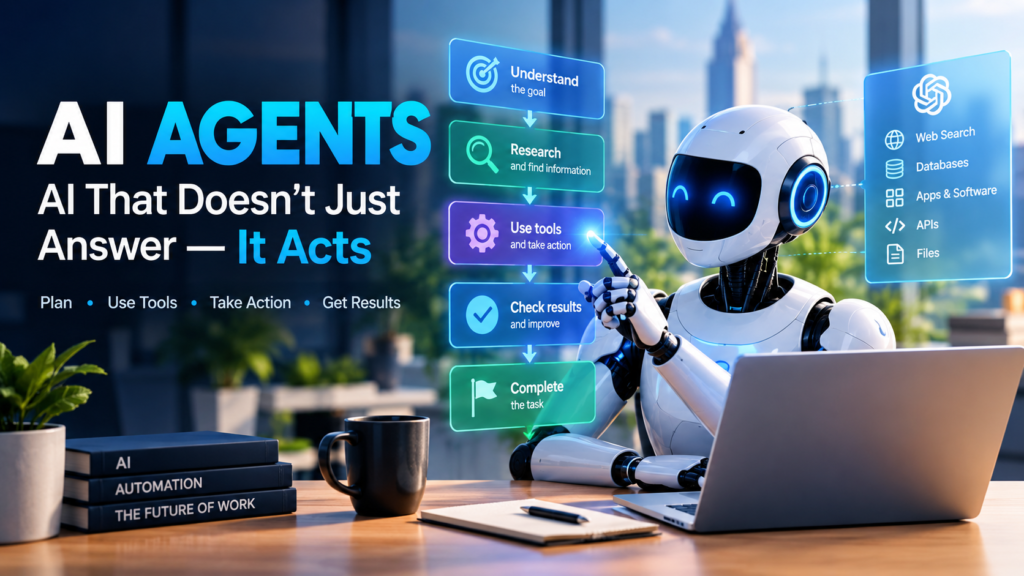
Goal → Plan → Use tools → Take actions → Check results → Continue or finish
For example, instead of asking an AI to simply write a report, an agent could potentially be given a broader task such as:
“Research this topic, organize the information, create a report and prepare it in the required format.”
Depending on the agent and the permissions it has, the system may break the goal into smaller steps and use connected tools to complete them.
OpenAI’s current guidance distinguishes agents from simple chatbots by their ability to control workflow execution and interact with external systems through tools.
What Is Agentic AI?
Agentic AI refers to AI systems designed to operate with a higher degree of autonomy.
Google’s September 2026 explanation describes agentic AI as AI focused on autonomous decision-making and action, where systems can set goals, plan and execute tasks with limited human intervention.
The terms AI agent and agentic AI are often used interchangeably, but there is a useful distinction:
- AI agent: An individual system designed to perform a task or achieve a goal.
- Agentic AI: The broader approach or architecture in which agents can reason, plan and act.
- Multi-agent system: Multiple agents working together on different parts of a larger task.
Think of an AI agent as a worker and agentic AI as the larger system that coordinates the work.
How Do AI Agents Work?
An AI agent typically combines several components.
1. AI Model
The underlying AI model acts as the reasoning engine.
It interprets instructions, processes information and helps determine what should happen next.
Large language models are commonly used as the foundation for modern AI agents.
2. Instructions and Goals
The agent needs to understand what it is supposed to accomplish.
For example:
“Find information about electric vehicles and create a comparison report.”
The goal gives the system a target rather than just a single question.
3. Tools
This is one of the most important differences between a basic chatbot and an agent.
Tools can allow an agent to interact with external systems, retrieve information, manipulate data or perform actions.
Depending on the system, these tools may include:
- Web search
- Databases
- APIs
- Software applications
- Code execution
- Business systems
- File systems
- Communication tools
Google describes tools as capabilities that allow agents to interact with their environment and perform more complex tasks.
4. Memory and Context
Agents may maintain information about the current task and, in some systems, information from previous interactions.
This helps them keep track of:
- What has already been completed
- What remains to be done
- Information discovered during the task
- Previous instructions
- Relevant user preferences
Memory architectures vary significantly between systems, so not every AI agent has the same type or amount of persistent memory.
5. Planning and Orchestration
A complex goal often needs to be divided into smaller steps.
For example:
Goal: Create a market research report.
The agent might need to:
- Gather information.
- Organize the data.
- Compare sources.
- Identify relevant trends.
- Generate a report.
- Review the output.
Modern agentic workflows can dynamically adjust their actions based on information encountered during execution rather than following only a fixed sequence.
6. Guardrails and Human Oversight
More autonomy also creates more responsibility.
AI agents may be given permissions to access data or perform actions, so systems need appropriate controls, monitoring and human oversight.
OpenAI’s agent guidance emphasizes tools, workflow control and guardrails, while Microsoft has also highlighted governance and security as important considerations when organizations adopt AI agents.
AI Agent vs Chatbot: What’s the Difference?
The easiest way to understand the difference is to look at action. Feature Traditional Chatbot AI Agent Answers questions ✓ ✓ Generates text ✓ ✓ Understands instructions ✓ ✓ Plans multiple steps Limited ✓ Uses external tools Sometimes Often Takes actions Limited ✓ Works toward a larger goal Limited ✓ Can operate with less supervision Limited Potentially
The distinction isn’t absolute. Modern AI assistants can include agent-like capabilities, and products use these terms differently.
Google similarly distinguishes agents from assistants and basic bots based on autonomy, task complexity and interaction style.
What Can AI Agents Do?
The practical applications are expanding quickly.
1. Research
An AI agent can potentially gather information from multiple sources, organize findings and produce a structured output.
This can be useful for:
- Market research
- Competitive research
- Literature reviews
- Industry analysis
- Data collection
Human verification remains important, particularly when accuracy and source quality matter.
2. Software Development
AI agents are increasingly being used in software-development workflows.
They can assist with tasks such as:
- Understanding a codebase
- Writing code
- Running tests
- Finding errors
- Making changes
- Reviewing results
OpenAI describes agentic systems as capable of working on longer-horizon tasks involving tool calls and iterative problem-solving.
3. Customer Service
Agents can be connected to customer-service systems to:
- Understand customer requests
- Retrieve relevant information
- Follow predefined procedures
- Perform certain actions
- Escalate cases to humans when necessary
4. Business Workflows
Businesses can use agents to automate parts of repetitive workflows.
Examples include:
- Document processing
- Data analysis
- Internal knowledge retrieval
- Report preparation
- Workflow coordination
- Administrative tasks
Microsoft’s 2026 Work Trend Index reports growing use of AI and agents in workplace settings and surveyed 20,000 AI-using workers across 10 countries for its research.
5. Personal Productivity
Consumer-facing agents may eventually handle increasingly complex digital tasks such as:
- Organizing information
- Preparing documents
- Researching options
- Managing repetitive digital workflows
- Coordinating information across applications
The exact capabilities depend on the product, integrations and permissions provided to the agent.
Why Are AI Agents Becoming Important in 2026?
One major reason is the evolution from content generation to task execution.
Generative AI made it possible to create:
- Text
- Images
- Code
- Audio
- Video
Agentic AI adds another layer:
What can the AI actually do with that capability?
Google’s current 2026 material describes organizations moving beyond basic AI assistants toward agents that can coordinate more complex business processes.
That doesn’t mean every AI system will become fully autonomous. In many real-world applications, humans will still define goals, approve sensitive actions, monitor results and handle exceptions.
What Are the Benefits of AI Agents?
Increased automation
Agents can potentially automate multi-step processes rather than just individual actions.
Less repetitive work
Routine digital tasks can potentially be delegated to AI systems.
Faster workflows
Agents can perform multiple steps without requiring a person to manually initiate every stage.
Tool integration
Agents can connect AI reasoning with external software and data.
Scalability
Organizations can potentially use agents to handle larger volumes of routine work.
However, these benefits depend heavily on the quality of the underlying AI model, tools, data, workflow design and safeguards.
What Are the Risks and Limitations?
AI agents are not magic digital employees.
They can make mistakes.
Potential problems include:
- Incorrect information
- Poor decisions
- Unexpected actions
- Security vulnerabilities
- Privacy concerns
- Excessive permissions
- Incorrect tool use
- Failure to understand context
An agent that can take action can potentially cause more significant problems than an AI system that only generates text.
That’s why production AI-agent systems require testing, monitoring, permissions and appropriate human oversight. Google and Microsoft both emphasize the importance of architecture, security and governance when deploying agents.
Are AI Agents Going to Replace Human Workers?
There isn’t a simple yes-or-no answer.
AI agents are designed to automate certain tasks and workflows, but the impact will vary significantly by occupation, industry and implementation.
Some tasks may become automated.
Other jobs may incorporate AI agents as productivity tools.
And entirely new responsibilities may emerge around managing, evaluating, securing and coordinating AI systems.
Microsoft’s 2026 Work Trend Index frames the development around humans working alongside agents rather than treating the technology only as a replacement for people.
The more useful question may therefore be:
Which tasks can AI agents perform, and which tasks still require human judgment?
AI Agents vs Agentic AI vs Generative AI
These terms are related but shouldn’t be treated as identical.
Generative AI
Primarily creates content from instructions.
Example:
“Write a 1,000-word article about electric cars.”
AI Agent
Can pursue a goal using reasoning and tools.
Example:
“Research electric cars, compare the latest models and prepare a report.”
Agentic AI
Refers to systems and architectures designed around greater autonomy, planning and action.
Simple progression:
Generative AI → AI Agent → Agentic Workflow
The boundaries aren’t perfectly fixed, and different technology companies use the terminology somewhat differently.
What Does the Future of AI Agents Look Like?
The next stage of AI development is likely to involve more connections between models, tools, software and real-world systems.
We are already seeing AI agents being developed for:
- Software engineering
- Business operations
- Research
- Customer service
- Productivity
- Data analysis
- Enterprise workflows
Microsoft, Google and OpenAI are all developing technologies and guidance around AI agents, reflecting the industry’s broader shift toward systems that can perform multi-step tasks rather than simply respond to prompts.
The important change is simple:
AI is moving from “tell me something” toward “help me get something done.”
Frequently Asked Questions
What is an AI agent?
An AI agent is a software system that uses AI to pursue a goal by interpreting information, reasoning about what to do, using available tools and taking actions.
Is ChatGPT an AI agent?
ChatGPT can provide agent-like capabilities depending on the features and tools available in a particular version or mode. A simple chatbot interaction, however, is not necessarily an AI agent. The important distinction is whether the system can control and execute a workflow using tools on the user’s behalf.
What is agentic AI?
Agentic AI describes AI systems designed to make decisions, plan actions and execute tasks with a higher degree of autonomy.
Are AI agents free?
Some AI-agent capabilities are available at no cost, while other products and advanced features require paid plans or usage-based pricing. Availability and pricing vary by provider.
Can AI agents use the internet?
Some AI agents can access web search or other online services when those capabilities are provided. Others operate only within specific applications or connected systems.
Are AI agents safe?
Safety depends on how an agent is designed, what information it can access, which actions it is allowed to perform, and what monitoring and human controls are in place.
Final Takeaway
AI agents represent an important evolution in how people interact with artificial intelligence.
Instead of asking AI to complete one isolated action at a time, users can increasingly give AI systems goals that involve multiple steps.
The technology is still developing, and capabilities differ substantially between products. But the direction is clear: AI is increasingly being connected to tools and workflows so that it can do more than generate information—it can help execute tasks.
The future of AI may not simply be about smarter answers. It may be about smarter action.
Related AI Guides
- AI Agents vs Chatbots: What’s the Difference?
- 10 AI Tools That Can Save You Hours Every Week
- What Are AI Coding Agents?
- Best AI Research Tools for Professionals
- What Is Physical AI?